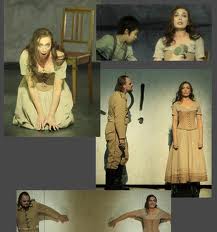
Showing posts with label Berg. Show all posts

Sunday, 20 January 2013

The Waltz X: The Last Waltz?


As the First World War drew near, audiences in Central Europe were being treated to waltzes from a composer who combined the melodic and rhythmic spirit of the Strauss Family with the scrumptious late-Romantic harmonies of Richard Strauss, Puccini and the like. Even Gustav Mahler was enamoured of the composer's best-known waltz - Lippen schweigen ('Silent Lips'), better known as 'the Merry Widow waltz'. Its composer Franz Lehár  was a man with a remarkable gift for writing achingly memorable melodies, such as the main theme of Lippen schweigen, and setting them against rich and masterfully-scored accompaniments. Though I seem to have known that tune since I was evicted from my pram, it was the quality of the various melodies that go into making the Gold und Silber ('Gold and Silver Waltz') such a popular favourite that first alerted me to the delights of Lehár. If you've never heard it before, please take the opportunity to do so now. As you will hear the waltz follows the traditional pattern, as does Wilde Rosen ('Wild Roses') - a piece of which the composer himself was particularly fond. In Wilde Rosen you can hear the ingenuity with which Lehár weaves delightful counter-themes around some of his melodies. This is typical of the man. Just listen to the orchestral richness of the Altwiener Liebeswaltzes ('Love Waltzes from Old Vienna'). The composer himself conducted extracts from several of his operettas, including waltzes from The Count of Luxembourg and Eva, helping to spread his own message. Lehár continued to enjoy success between the wars, but as a popular phenomenon his was a dying art, losing out - especially after the Second World War - to the encroaching form of the musical.

Talking of which...one of the many gems from George Gershwin (and, of course, his brother Ira) was a song originally written for a review called The Show Is On about a lady who likes just one composer...and it isn't Lehár or Gershwin. By Strauss!: 

When I want a melody
Lilting through the house
Then I want a melody
By Strauss
It laughs, it sings
The world is in rhyme
Swinging to three-quarter time 
I suspect she would have been a fan of Arnold Schoenberg's arrangement of Strauss waltzes though I also suspect that she wouldn't been quite so keen on Schoenberg's own take on the form - the Waltzer from the Five Piano Pieces, Op.23. This is among the composer's first wholly twelve-tone works - and is unquestionably the first ever twelve-tone waltz. You won't be able to dance to it, despite the waltz rhythms. It's more of a fantasy-piece. As for his Strauss-waltz-arranging disciples, well, Anton Webern wrote no original waltzes of his own. Alban Berg, however, made conscious allusions to the Viennese waltz in his beautiful Violin Concerto of 1935 (very clearly in the 'Wienerisch' section around five minutes in). These, however, are essentially memorials for the waltz.


Of course, as we saw in Russia, the waltz lived on beyond the end of the First World War - and beyond La Valse - even if its glory days had well and truly gone. You see a waltz movement here and a fleeting glimpse of the waltz there among the works of many a famous 20th Century composer, but - as with the Schoenberg and Berg examples - they are fleeting things, memories, nostalgic or ironic glances backwards, parodies, mockeries. The waltzes in Richard Strauss's Der Rosenkavalier were already tending in that direction before the Great War, and his only concert waltz, München was originally written in 1939 but then re-written with a minor-key section in 1945, with the addition of the words "ein Gedächtniswalzer". It was a memorial waltz - a memorial to Munich, its opera house and to the waltz.

It needed a memorial. Of course, in popular music the strains of the waltz lingered on. Film composers also found many-and-varied uses for the waltz. Light music composers kept the waltz flame flickering too. Composers of musicals often reach for a waltz. My survey of the music of Paraguay's greatest composer Barrios showed the waltz thriving in the bars of Latin America. Ballroom dancers the world over are still dancing away to waltzes. Many sub-species of the waltz have sprung up across the globe. But among the major classical composers the waltz went into serious decline. Given that people still love a good waltz, that's a shame, isn't it?

Let's not end on a triste note about la valse. I've got quite a few miscellaneous waltzes to offer you, to round things off.

Fancy a pair of Edvard Grieg Valse-caprices for piano duet? Dating from 1883, they make a charming set. I think the first is the best, with a melodic appeal that should win its many friends. It really does speak the language of its composer, albeit with waltz rhythms rather than with Norwegian folk rhythms. The major/minor shifts in the trio section of this Valse-caprice are particularly characteristic. I'd never heard them before but I was aware of Grieg's involvement with the form. His series of sixty-six Lyric Pieces contains many an attractive waltz. I've always enjoyed playing the Vals, Op.12/2 - another gem where unpredictable major and minor shifts add a touch of Griegian magic. For a spirited take, please try the Vals, Op.38/7 - short but charming. The Norwegian folk influence is felt in the captivating melody of the Valse-Impromptu, Op.47/1, another magical number, with its tune based on an unusual (but very characteristic) take on the minor scale. The Valse mélanconique, Op.68/6 is more conventional but has much to recommend it.

Moving from the far north to the far south of Europe, we find the waltz flourishes in the hands of the Chopin-soaked Enrique Granados. His Valses Poéticos takes the traditional form of an introduction, waltz sequence and reprise-coda. From lightness to melancholy, nobility to sentimentality, Granados's richly-imagined set offers the listener many rewards. Listen out in particular for the 6th waltz - the one marked 'sentimental'.

Such pieces come from the heart of the Romantic piano composer tradition. We've already looked at Liszt's Mephisto Waltzes - those waltzes that were so hard to hear as waltzes. Liszt wrote quite a few non-devilish waltzes too. I'm not sure that many pianists would agree that the early Grande Valse di Bravura isn't devilish, given the devilishly difficult demands it places on the performer! This is an entertaining piece in the most brilliant salon style of the time. From the more intimate side of Liszt's nature came the lovely Valse mélancolique - one of many works the composer reworked over the years. You can trace this process in action by journeying (happily) through the transformation of the first version of the Petite Valse favorite into the second version of the Petite Valse favorite and from there into the Valse-Impromptu. Delightful music! Nor must I forget the Valse oubliées. These are very special waltzes from Liszt's later years. No.1 has always been a favourite, for understandable reasons. It has all the best tunes. No.2, however, is a dazzling and dream-like fantasy, full of beauty and not to be missed. No.3 enters into visionary harmonic worlds to come (as late Liszt was so often to do) and is, if anything, even more airy and beautiful. No.4, ironically, was literally a forgotten waltz for many years, only being rediscovered in America and published in 1954. It is even closer to the soundworld of Scriabin and full of flare and fire. The Valse oubliées are indeed something special, unlike...

Did you know that Liszt's son-in-law Wagner wrote a waltz? The Zuricher Vielliebchen Walzer for piano of 1854 is that most surprising of things. I think you'll agree it's hardly a masterpiece, but it's a charming trifle nonetheless. Who'd have thunk it? That's really it though for Wagner and the waltz (except for an arrangement he made of Wine, Women and Song) - unless you are prepared to countenance my passionate belief (which I will defend to the death - and beyond) that the Flower Maidens' beguiling Komm o holder Knabe from Parsifal is a waltz!


Let's leap across the Atlantic and forward in time (before working backwards again). Two of the three great ballets of Aaron Copland feature waltzes. There's the Saturday Night Waltz from Rodeo - a lovely slow waltz announced by the 'tuning-up' of the 'fiddlers' of the orchestra. There's also the no-less-lovely slow Waltz that precedes Billy's death in Billy the Kid. Both give a flavour of how the waltz had become a popular dance in the America of yore.

Charles Ives had penned a characteristically off-centre take on the waltz a quarter of a century earlier. His Waltz-Rondo of 1911 has strange and purely coincidental echoes of the Ravel Valse nobles et sentimentales, among other anticipations. It's a rich and fascinating piece that's as oblique a take on the waltz as Schoenberg's Op.23 piece a decade later. Less complex (but charming) is the Waltz parodying the popular waltzes of the time that Ives wrote in 1895, as arranged by Jonathan Elkus in 1971. (The original song can be heard here). This is the waltz as a sentimental song (or a take thereon).

American composers of Ives's were still showing themselves to be smitten by the great masters of the classical waltz, especially Chopin. There's Horatio Parker, for example,with his Chopinesque Valse gracile of 1899 and George Chadwick with his equally Chopin-inspired (and highly agreeable) Three Waltzes of 1890.

This American process is a rewind of the process we have been seeing in Europe - the move from the real thing to parodies and nostalgic memories of the real thing.

Let's end with another American composer but one who began as an Austrian composer and whose music is Viennese to its fingertips, Erich Korngold. His work in arranging rare Strauss operettas brought a fair few of them back from the dead. Korngold's music is rich in influence, sharing some of the spirit of Franz Lehár whilst also being aware of Schoenberg. Of course, Korngold is best known for his film music, all written for the studios of Hollywood. A man of the past and the future then. I've enthused about Korngold's music (at length) before, so this is my second bite of the cherry here. It's such a tasty cherry though that I'm always happy to keeping nibbling at it.

As well as those arrangements of Strauss operettas, Korngold wrote a pastiche singspiel called Walzer aus Wien ('Waltzes from Vienna') which drew on Strauss's less-known music (the Broadway version was called The Great Waltz) to tell a story from the life of the Waltz King. For a flavour of what must be a wonderful piece, please take a listen to the waltz-aria Frag mich Oft . (A second delicious aria may be heard here.) One of Korngold's final works was a short orchestral tribute to the great man, Straussiana, drawing on an obscure Strauss polka and an obscure Strauss waltz. There's not a hint of irony in it. This is love.

Korngold wrote waltzes of his own, including in his remarkably prodigious youth. I like the story about the teenager's Vier fröhliche Walzer all being dedicated to friends at school - all girl friends - and his father confiscating the young composer's manuscript to try to deter him from thinking about girls! The pieces were re-discovered later. As you would expect from the extraordinarily gifted youngster, the waltz Margit sounds like the work of a fully mature composer and contains a rich flow of melody and harmony. For a waltz from a work from the composer's actual maturity, please try the warmly nostalgic second movement from the Suite Op.23 for two violins, cello and piano left hand or the delightful finale of the String Quartet No.2, Op.26 - both first-rate waltzes. If you ever feel yourself wanting to sing along to a Korngold waltz you will be in good company - as you can hear from the composer's own performance (on piano) of the waltz-song Die schönste Nacht from his operetta Die Stumme Serenade. Try it for yourself with the waltz, Feast in the Forest, from his legendary film score The Adventures of Robin Hood or with Pierrots Tanzlied from the composer's most famous opera, Die Tode Stadt.

Resisting the urge to end with Engelbert Humperdinck's The Last Waltz, that's the end of this short series of posts on the waltz. Hope I didn't leave out too much! 

The Waltz V: Wine, Women and Song...Yes Please!


It's both surprising and delightful to discover that all three members of the dreaded Second Viennese School - Schoenberg, Berg and Webern - made arrangements for a small salon ensemble of several of the most delectable waltzes by Johann Strauss the Younger. It's a real treat to hear them them all. 

The three Schoenberg arrangements - Roses from the South, Op.388, the Lagunen-Walzer, Op.411 and the Emperor Waltz, Op.437 - are straightforwardly charming. The Lagoon Waltz is drawn from the operetta A Night in Venice and also gives me the chance to link to a favourite YouTube video of mine - an enchanting performance of the Act III waltz-song Ach, wie so herrlich zu schau'n. Bliss!!

Webern's arrangement of the lovely Schatz-Waltzer, Op.418 ('Treasure Waltz') from The Gypsy Baron is characteristically graceful. If you fancy hearing one of its best tunes in its original form, why not try So voll Fröhlichkeit?

Best of all though is Alban Berg's arrangement of Wine, Woman and Song, Op.333. That Berg was the one to arrange this particular piece seems entirely fitting as all of those three delightful things clearly meant the world to him. "Who loves not wine, woman and song, remains a fool his whole life long" was the old adage that inspired Strauss's masterpiece. Ah, wise words indeed! They are said to have been said by Martin Luther of all people (whilst taking refuge in the Wartburg) - which does surprise me, if true. This is one of my favourite Strauss waltzes and I've always found it gratifying that both Brahms and Wagner also felt great affection for it. That Berg loved it too is just the icing on the cake. The warmth of his arrangement is surely proof of that love. A lesser-known fact about the piece as Strauss originally composed it is that it was written for male chorus and orchestra - a version you can listen to here. And if you're still pining for the much more familiar orchestral version, please have a listen to it here. Who loves not Wine, Woman and Song, Op.333, remains a fool his whole life long!

......

The Waltz IV: The Kings of Swing

By one of those quirks of Google blogger, this post doesn't seem to be visible. As it's (in many ways) the central post of the series, I will re-add it here and hope that it doesn't result in duplication for you. Enjoy!!:


As Chopin was writing out his waltzes and Berlioz was fantasising about a scene in a ballroom, the Strauss Family's father, Johann Strauss I, was getting into his stride. The craze for the waltz may have been starting to fade in Britain and France but it was exploding in the capital of the land of its birth where, alongside Lanner, Strauss the Elder gave the Viennese and the waltz a massive shot in the arm. We don't tend to hear a great deal of Johann the Elder's music, even at the New Year's Day concerts in Vienna - with one very obvious exception, the inescapable clap-along Radetzky March (named in honour of the Austrian field marshall Joseph Radetzky von Radetz) - but there are some delightful waltzes to be had from Strauss I (even if none of them has the magic of the best of Johann the Younger).

His best-known waltz is Lorelei Rheinklänge, Op.154 but (to put my explosion imagery earlier to good use!) his Ballracketen, Op.96 is even more delightful. As a Brit, I can't resist also linking to his Huldigung der Königin Victoria von Grossbritannien, Op. 103, a waltz that begins with Rule Britannia and ends with God Save the Queen

The zenith of the Viennese waltz, however, came in the second half of the Nineteenth Century when the waltz passed from father to sons - namely Johann Strauss II and his brother Josef and Eduard. Supreme artistry and popular appeal mark out Johann Strauss the Younger's contributions to the genre. His gift for a good tune was second to none and, along with his almost-as-gifted brother Josef, he invested a great deal of poetry in many of his introductions to the waltz. Johann Strauss II expanded the waltz sequence (often including an introduction and coda) as set out by Weber and added richer melodies, harmonies and orchestral colours to those of his father. 

He was a prolific composer, so offering you a decent selection of his waltzes is both easy (so many to choose from) and hard (so many to choose from). I will save some of the most famous for a later post, where they will be heard in intimate arrangements by an unlikely group of composers. OK, let's start with a popular piece, Frühlingsstimmen, Op.410 ('Voices of Spring') which shows, I think, why this Strauss is the best Strauss. It may lack a slow introduction but the sheer quality of the waltz tunes puts it in a league of its own. A whirling theme, a tune from the country with birdsong (on flute), a more wistful melody of much beauty and a jolly tune to lead us towards the close. The waltz's vocal version is sometimes included in performances of Die Fledermaus, where is it entirely at home. The whole thing is delightful and invites comparison with the piano waltzes of Chopin. I played arrangement of popular Strauss waltzes on the piano as a youngster, so many - like Voices of Spring - feel like childhood friends to me. I would try to ooze flexibility during the lovely slow introduction to Wiener Blut, Op.354 ('Vienna Blood') and then straighten up for the grander bits. Wiener Blut was written for a royal wedding, so celebratory grandeur had its place in the waltz alongside the customary charm and the loveable easy-going waltz tunes. 

It would be perverse not to include An der schönen blauen Donau, Op. 314 ('The Blue Danube', as if I really needed to translate that for you!) The tremolo strings evoking the shimmering surface of the water, the motif based on the notes of a major triad on horns (and sometimes strings) evoking the grandeur of the river, the answer high woodwinds chords evoking the glint of light on the river, the long bass notes evoking the depth and breath of the river...all those familiar, too-easily-taken-for-granted features found in the famous introduction...so well-known and yet still so impressionistic, so magical. And the waltzing hasn't even begun yet. A curious fact here is that the waltz didn't go down a storm at its première, rather unusually for a Strauss waltz. Audiences have been reacting far more appreciatively ever since! 

"What about some rarities? I mean, come on Craig, the flipping Blue Danube for goodness sake!"

Well, how about a tribute to another river, An der Elbe op. 477? The slow introduction is another lovely evocation of a river in flow - more shimmers, more triad-based magic, but also some magical light-on-water effects that don't sound a million miles away from Wagner and his Forest Murmurs. The waltz sequence that follows has plenty of tuneful appeal too. It's quite a find. So is Gartenlaube, Op.461 ('Garden Trees', I think), with its charming woodwind-dominated introduction and its deliciously-scored main theme. Music to charm the birds from the trees! And talking of charming woodwind writing, you might also enjoy the introduction to Gedanken auf den Alpen op.172 ('Thoughts in the Alps').


Going back to the start of his career, his Jugend-Träume op 12 ('Youthful Dreams') is notable as being its composer's break-through piece, winning five encores at its first performance back in 1845. All the ingredients are there - an imaginative introduction, a memorable lilting main theme and an easy flow of waltzes.

To finish though this short survey of an artist's life, it's time a couple more famous ones to finish, both from the height of Johann the Younger's fame - Künstlerleben op.316 and G'schichten aus dem Wienerwald, Op.325  ('Tales from the Vienna Woods'). The latter must be heard with its slow introduction, for it is a thing of delight. Open fourths and fifths suggestive of nature call beckoningly on winds, a drone begins and a grand invitation to the dance is issued. A solo cello sings to us and gentle melodious fills us with warmth. A bird sings and the zither (or muted strings) sings its magical song, calling us to the Vienna Woods. A sequence of five waltzes and a coda (with reprise) follows. Any performance that omits that introduction should be roundly booed. (Only joking!)

As for Josef Strauss, I refer you to to a post of mine from a year ago, New Year Swallows from Austria, for an appreciation of his art - especially his gift for crafting beautiful introductions. I shall re-quote his brother Johann here about Josef: "Pepi [his family nickname] is the more gifted of us two; I am merely the more popular." I think Johann was being overly modest there, but there's no doubt that his brother's gifts were of a high order. As a fresh example of his genius, please try his Geheime Anziehungskrafte (Dynamiden), op.173. The title evokes the secret powers of attraction and the play of atoms and the introduction to the waltz sequence conjures a dream-like vision in much of symphonic power. As I said in my earlier post about Josef, it does rather seem a shame that he couldn't have dropped the waltz sequence altogether and expanded his introduction into a miniature symphonic poem. Still, the reliably tuneful, colourfully-orchestrated waltz sequence gives the listener such a good feeling that such qualms almost dissolve. The main waltz tune here begins with nine notes that fans of an unrelated Strauss, Richard, might recall as being the same first nine notes of one of his waltz tunes from Der Rosenkavalier (5.11 into this link). It could be co-incidence, of course (after all, it's a simple waltz tune formula that could easily keep cropping up), or it could be a deliberate echo by Richard. Who knows! 

What though of brother Eduard? Eduard Strauss was definitively in his brothers' shadows and made a speciality of polkas and conducting. His waltzes - such as Schleier und Krone, Op.200 ('Veil and Crown'), written for an Imperial wedding, Glockensignale, Op.198 ('Bell Signals') and Doctrinen, Op.79 ('Doctrines') - show talent but I can't detect the spark found in his brothers' finest pieces. Can you?

Eduard's eldest son, Johann Strauss III, became the last of the Strauss dynasty (dying in 1939) - not that you ever hear his music. (Well, until now that is!)  By all accounts, the lad got off to a disastrous start with one of his pieces going down so badly with the public that he was told by critics to use a pseudonym so as not to tarnish the family name. (Ouch!) Trying out his Unter den Linden Walzer, Op.30 and Kronungs-Walzer, Op.40 ('Coronation Waltz'), written for the coronation of our own Edward VII, shows that he got over this crisis and went on to be a highly competent Strauss - if not a great Strauss. I wouldn't mind hearing more of JSIII. 

The Strauss Dynasty (1804-1939), purveyors of pleasure in three-four time to millions for almost two hundred years now. Long may that continue!

Sunday, 9 September 2012

Alban Berg: The Second Viennese Romantic


Of the three members of the so-called Second Viennese School, Alban Berg (1885-1935) has proved to be most popular with the public. Why is that that? Well, his music tends to be far more immediately alluring. It is more conservative-sounding and the closest in spirit to most listeners' favourite kind of classical music - Romantic music. At heart a lyrical composer, Berg nearly always made sure that his music spoke straight from the heart - even when, as we now know it often was, he had constructed it with an astonishing degree of compositional rigour and an obsessive attention to detail. Moreover, his melodies - whether tonal, atonal or serial - stick in the memory more often and far more easily than those of Schoenberg and Webern and can carry you along as strongly as any wave of Romantic melody. His orchestration is also much more colourful, refined, lavish and sensuous. Furthermore, his tonal tendencies were by some margin the strongest of the three composers - paradoxically especially after he finally embraced serialism (in his own way). Finally, he is the Second Viennese composer whose music sounds most like Mahler - and who doesn't like Mahler? 

I bought a CD of the LSO and Claudio Abbado conducting the Lulu SuiteAltenberg Lieder and Three Pieces for Orchestra over twenty years ago and played it almost as obsessively as Berg measured out the sections of his pieces! It was glorious, passionate music that swept you up and made you dizzy - sometimes fierce and strange, often ravishingly beautiful. 

That Berg's roots were deeply lyrical can be heard from his early songs. Listening to his lovely early Heine setting Geliebte Schöne shows a composer already adept at writing songs. There's plenty of Brahms in it, plus a flavouring of Mahler. Schumann's influence shows up in the Theodor Storm setting Schliesse mir die Augen beide. Having (hopefully) enjoyed that particular Storm setting from around the start of the 20th Century, please next try the 1925 version of Schliesse mir die Augen beide. This was Berg's first fully serial piece and the shapes of its melody are angular, in the way of much twelve-tone melody. The phrasing, however, remains essentially lyrical and the piano accompaniment is rich and delicate in a way that is very different to either Schoenberg or Webern, being closer (in texture if not harmony) to Debussy than either. The harmony also has tonal elements (deliberately).


The best of the early songs (composed rather later than most of the others) were gathered together by Berg in 1928 as his Sieben frühe Lieder. This means that were get to hear seven of the composer's loveliest tonal songs orchestrated in the masterly and charismatic manner of his full maturity. In general terms, orchestral songs as a medium are often some of music's tastiest offerings - and these are very tasty specimens indeed. The songs are:

1. Nacht ('Night'), setting Hauptmann.
2. Schilflied ('Reed Song'), setting Lenau.
3. Die Nachtigall ('The Nightingale'), setting Storm.
4. Traumgekrönt ('Crowned with Dreams'), setting Rilke.
5. Im Zimmer ('In the Room'), setting Schlaf.
6. Liebesode ('Love's Ode'), setting Hartleben.
7. Sommertage ('Summer Days'), setting Hohenberg.

Many of the great Romantics can be heard as influences here - everyone from Schumann and Brahms to Wagner (does anyone else hear his Elsa in In Zimmer?) and Mahler. I also hear strong echoes of Richard Strauss. The loveliest passage in Schilflied (beginning at "Wenn sich dann der Busch...") shows that influence clearly, as does the superb surging phrase at "Rie Rosen aufgesprungen" in Die Nachtigall. (I suspect the apparent echo of the famous second subject of the first movement of Tchaikovsky's Pathetique symphony in Die Nachtigall might be a coincidence.) Nacht shows a chronologically closer influence, Debussy. The opening bars, depicting clouds and mists, use the whole-tone scale. There's a wonderful surge of tonality in this song at the phrase "Weites Wunderland ist aufgetan".


Of course, another influence was entering Berg's life as he was writing these songs - his teacher Schoenberg, whose First Chamber Symphony was to help shape the pupils first published work, the Piano Sonata, Op.1. The Schoenberg piece is a heady single-movement work notable for its chromatic extending of tonality, its teeming interweaving of themes, its use of sonata form and its hyper-Romantic gestures. It also makes thoroughgoing melodic and harmonic use of intervals of the fourth (perfect fourth, augmented fourth, diminished fourth). All of these features are also found in the Berg Sonata - though, as a Scriabin enthusiast, I would also note that such fourths-based writing was something which the famous Russian was also exploring in a thoroughgoing fashion at this time and that Berg's Sonata actually sounds as much like Scriabin as it does like Schoenberg.  There was something in the air. Both Berg and Scriabin certainly knew how to flood the keyboard with sonority. The opening melodic notes consist of a rising perfect fourth followed by a rising augmented fourth (tritone). This theme's companion features a falling tritone. There's an exposition, an exposition repeat, a development section, a recapitulation and a coda. There's a big climax in the development section but the work's harmonic conflict is only resolved in the coda, where the tritone turns into a perfect fifth. The work is sort-of in B minor, but the extended tonality is already beginning to extend itself beyond tonality. Berg was 21-years old when he wrote it.

In his Vier Lieder, op.2 inhabit a somewhat similar world of extended tonality. The final song is often said to mark the point where Berg crossed over into atonality. Even though it abandons key signatures (unlike its three companions), I have to say it doesn't sound any more or any less atonal than the other songs in the set. The songs (the first setting Friedrich Hebbel, the other three setting Alfred Mombert) are primarily focused on the idea of sleep ("Schlafen") - except for that final song.   The first, Schlafen, Schlafen, is particularly beautiful. It reminds me somewhat of Strauss's Ruhe, meine Seele! but is considerably more chromatic. Listen out for the superb setting of the words "keinen Traum". The second song, Schlaffend trägt man mich, is richly romantic but even more chromatic. Listen out here for the ending, where the closing line "in mein Heimatland" is particularly lovely. The voice holds the first syllable of "Heimatland" before falling, with the piano, over strange, chromatic harmonies. Nun ich der Riesen Stärksten, the short third song, breaks out of Strauss-Schoenberg-style chromaticisim for a passage of diatonic radiance at "an einer weissen Marchenhand". That 'atonal' final song, Warm die Lüfte, is more notable for its word-painting, with "the nightingale" and "the cold snow" that "melts and glitters" being directly evoked. It is the most dramatic song of the set, anticipating the opera composer to come.

Helene Berg

The real move into atonality came with the two-movement String Quartet, Op.3 (Mvt.2). Here the Schoenberg influence, including the score's complex thematic part-writing, is put at the service of heightened drama and there are some intensely involving passages that predict the composer of Wozzeck to come. According to the account of Helene Berg, the piece dates from a period before her marriage to Alban when they were forbidden to see each other. Alban's feelings of frustration, were, she said, channelled into this Quartet. That is easy to believe as the piece feels like an outpouring of intense feeling. I would say, however, that this piece is the one that those of you who struggle with the Second Viennese School's non-tonal music might find a difficult part of Berg's output to come to terms with. The tonal leanings of earlier and later Berg are least clear here. Still, it is a glorious score and becomes ever more fascinating with each listen. The first movement is in sonata form, while the second movement approximates to rondo form.  The scoring of the Quartet is masterly. Berg was, as ever, an expert colourist here.

Talking of colour, the next piece he composed, the Altenberg Lieder, Op.4, marks his first venture into writing for the orchestra. The songs, written for mezzo-soprano, set poems written on postcards by the Viennese poet Peter Altenberg and, though small-scale time-wise, they're large-scale in terms of scoring and expressive impact. The language is atonal but still manages to sound rather Mahlerian and, at times, like the Strauss of Elektra. The first song, Schneesturm ('Soul, how much more beautiful are you'), opens with a magical orchestral tone-poem (built from interlocking ostinati that blow here and there harmonically) depicting a snowstorm. A lovely rocking woodwind figure leads to the singer's entry - a beautiful phrase floated over rich harmonies. The second song, Gewitterregen ('Did you see the forest after the rainstorm'), is lovely. The singer enters unaccompanied, then gradually the orchestra joins her - a poetic passage of chamber music-like refinement that 'glitters and is quiet'. Note the wonderful melisma on "schöner" and the soft gong-stroke at its close. The third song, Über die Grenzen des All ('Beyond the boundaries of the universe'), is haunting and an Expressionist masterpiece. Over an abyss of dissonant cluster-harmonies the singer traces a slow, chromatic line, falling onto a low B. At the end the same line is traced but for the final note the singer leaps a tenth to land on a high C - a great moment to end a fine song, especially as the harmonic cluster beneath has been coloured by tiny gems of percussion. Nichts ist gekommen ('Nothing has come') is expressive of a depressive state of mind, with wan woodwinds, yearning strings and (for pleasure's sake) dainty flecks of percussion. Listen out for a harmonic shift of Mahlerian provenance. The final song, Hier ist Friede ('Here is Peace'), is the longest - and, in my opinion, the best, bringing out the most beautiful side of Berg's writing. The delicate orchestral prelude is particularly ravishing and moving and prepares us for the singer's - and the string section's - rich, emotive writing, looking on longingly towards the great operas and the late violin concerto. There's also an unforgettable moment, where a terrifying climax magically dissolves before our ears into a harp-blessed new world of harmony, and the singer's ecstatically high "Siehe" leads us into heavenly late-Romantic string writing before the delicacy of the opening returns for the haunting prelude. Gorgeous.


A set of atonal miniatures for clarinet and piano may sound more like the sort of thing Webern would have written but Berg's Four Pieces for clarinet and piano, Op.5 are typical Berg in their Romantic gestures and have, to my ears, a lyrical warmth to some of their passages that recalls the autumnal late miniatures of Brahms. The lyrical impulse, always so strong with this composer, is countered (kept in check) by the use of drier figures (ostinati) and by occasional passages of puckishness. After one such cheeky phrase, the opening piece unfurls a dreamy strain of clarinet melody against countermelodies in the piano, almost lifting off into a waltz at one stage before a whimsical, absent-minded-sounding ending. The wintry, introspective second piece features a sad melody for the clarinet over soft bell-like piano chords. The melody sinks down at the end into the instrument's lowest registers, as if giving up in dejection. There's more introspection in the central passage of the third piece but its mood is challenged by the capricious scherzo-like outer sections. The final piece returns to the spirit of the second piece and uses rather similar methods, setting a wintry clarinet melody over bell-like piano chords, but being a little more expansive it has time for an ascent into the higher registers, a dramatic outburst and a wistful coda. These are wonderful little pieces and should be better known. Schoenberg seems to have found them too lyrical, too song-like and told the composer off, provoking his obedient pupil to look to larger-scale writing. The result was the Three Orchestral Pieces and Wozzeck.

Critical accounts will tell you that the now legendary complexity of thought that underpins so much of mature Berg was already strongly at play in the Three Orchestral Pieces, Op.6 but, as so often, the listener is barely aware of that and is much more likely to be swept along on a rich wave of melody, ever-changing textures, exciting dramatic ebbs and flows, captivating orchestral colours and unpredictable but right-sounding harmony.


The first movement, Präludium, begins in a magical haze of unpitched percussion. Out of the haze winds emerge before being blown away by a gargantuan clenched first of brass. The movement's debt to Mahler is repaid in the following pages as a march-haunted stream of fine melody surges in, climaxing thrillingly (with percussion to the fore). Following this catastrophe the hidden march emerges - a great snatch of melody - but dies away into a mysterious passage that surely recalls the 'cowbells episode' from the opening movement of Mahler's Sixth Symphony. A short lament follows, sighing into the closing return of the unpitched percussion. The central movement, Reigen (the title of this section means 'Round dance'), begins with more echoes of the 'cowbells episode' before presenting us with an intricate skein of themes and colours which, despite its pastoral-sounding moments, has a haunted feel too, ending in a tense but deeply beautiful shiver. Schoenberg's way of weaving themes into a complex polyphony is at work but Berg is far too much his own man to make it sound like Schoenberg. You'll hear everything that matters without having to tax your ears. As well as that opening, I listen out each time for the lyrical violin solo, the arrival of waltzing rhythms, the extraordinary harmonies, the magical celesta (shades of Holst's The Planets), the harps, the ferocious brass attacks, the great terraced climaxes....So much to enjoy. The closing Marsch is the longest movement and even more Mahler-like than its companions, though it's orchestrated in ways that even Mahler might have gasped at. The movement is full of suffering and dark violence, with such a sense of dramatic pacing that a concealed programme might be suspected.


Suffering and dark violence pervade both of Berg's operas and the Marsch finale of the Three Orchestral Pieces in particular leads us neatly into the world of Wozzeck, Op.7. Berg himself encouraged interest in the opera by preparing a taster score, his Drei Bruchstücke aus "Wozzeck" - a highly successful gambit that led to the opera becoming very widely performed. If you do not know the opera you might also like to try the Three Fragments first (twenty minutes-worth of music drawing on a scene from the first act and two scenes from the third act (including the opera's closing scene) to get a sense of the rich world you are about to enter.

Wozzeck is scrupulously planned, with its three acts being hung on the following scaffolding:
Act 1: Suite, march, lullaby, passacaglia, rondo
Act 2 (Symphony): Sonata movement, fantasia & fugue, largo, scherzo, rondo
Act 3: Six 'Inventions'.
...which information, duly (and dutifully) imparted, will mean very little to you as you acquaint yourself with the continuously-flowing invention and emotional pull of Berg's tragedy (the synopsis of which you can read here). The technical underpinnings may be stupendously elaborate but the music that results sounds anything but dry or over-thought.

Instead of talking about leitmotifs and other such technical details, I'd like to select a few scenes from Wozzeck instead, beginning with Act 1/ii, where you can hear how naturally Berg uses Sprechsgesang (musically-inflected speech) alongside conventionally-sung melody (including a folksong). This scene ends with Wozzeck's haunted vision of the whole world being on fire (due to the setting sun turning the horizon read) and shows how Berg's orchestral writing is as vital as Wagner's in conjuring up the spirit of the drama. Act 1/iii introduces Marie to the music of a march, to whose strains she sings along happily, and features the indelible beauty of her lullaby - a lyrical passage that lingers long in the memory. The central confrontation of Act 2/iii is the slow movement of Berg's operatic 'symphony', while the following scene shows the composer's uncanny ability to use tonal music as an ingredient in his atonal score - of course for good dramatic reasons, but this knack was to recur in later works, most wonderfully in the Violin Concerto. Another especially haunting passage of the opera comes with the opening scene of Act 3, where Marie reads the story of Mary Magdalen in sprechsgesang then breaks into sung melody when then describing what she has read. A solo viola plays a memorable role here. Act 3/ii, the scene where Wozzeck murders Marie, is followed by a remarkable interlude featuring a long crescendo on a single note, rising from a quiet solo horn through the entire orchestra until, after some violent thuds, a second crescendo sweeps up the percussion section too. Suddenly an out-of-tune piano enters, banging out a polka and we are carried off to an inn. The interlude leading to the incredibly moving closing scene is a deeply beautiful lament for Wozzeck, recalling many of the earlier themes of the opera (those leitmotifs) in a manner that has its roots in Wagner. It is one of the most glorious things in music.


We are still not in the world of twelve-tone music. We are moving in that direction though and the Schoenberg-Berg-Webern triangle so closely associated with it was the subject of the next piece in Berg's output - the Kammerkonzert for violin, piano and winds. If you listen to its opening you will hear three themes presented one after the other. The one on piano  represents Schoenberg, the one on violin Webern and the one on horn Berg himself. (They were formed out of the musical letters of each composer's name, in the time-honoured tradition of BACH and DSCH).


The first movement is a set of variations for piano and orchestra, the second an Adagio for violin and orchestra and the third a Rondo (with introduction) featuring both piano and violin. Not wishing to put you off, but the Chamber Concerto has never been popular with Bergians and it's never been popular with me. The good cheer of its outer movements doesn't feel quite right with this composer, and it's the one time where the academic aspects of the Schoenberg School's project actualy come to the surface in Berg's music. The central movement, however, is a beautiful (if long) piece of music and is often performed alone. Please judge for yourselves though.

With the Lyric Suite for string quartet we return to the heights. Like Bartok, Berg had a highly developed sense of what string players could do and was not afraid to tax them with advanced playing techniques. Also like Bartok (but unlike certain other composers), this was done purely for expressive effect. The Lyric Suite (partly named because it quotes from Zemlimsky's Lyric Symphony, but also because it is unquestionably deeply lyrical) is full of fresh sounds as a result. We now know that, along with its intense structuring and obsessive attention to detail, the score also contains (Schumann-like) hidden codes through which the composer poured out his extra-marital love for another woman, Hanna Fuchs-Robettin (pictured below). So, we are dealing with a deeply personal piece of music here - albeit one with a strong musical backbone.


Following his first foray into twelve-tone serialism with the second setting of Schliesse mir die Augen beide (an experiment comparable to Wagner's preparatory studies - the Wesendonck Songs - for Tristan and Isolde), Berg used that song's tone-row as the starting point for his Lyric Suite. As Berg never took a doctrinaire approach to Schoenberg's Big Idea, he didn't stick to applying that row and only some of the Lyric Suite's movements bother to embrace it. Typically, the row itself contains tonal elements - two minor triads easily arise out of it, which on inversion become two major triads. That's Berg for you!

There are six movements (whose markings convey a good sense of their characters):
1. Allegretto gioviale
2. Andante amoroso
3. Allegro misterioso...Trio estatico
4. Adagio appassionato
5. Presto delirando...Tenebroso
6. Largo desolato
The odd-numbered ones are fast and get ever faster. The even-numbered ones are slow are get ever slower. Which ones are twelve-tone? Movements 1 and 6, plus the outer sections of Movement 3 and the Tenebroso of Movement 5. The others are atonal (in the Bergian sense of 'atonal'). The movements project an array of contrasting moods, often within themselves. The warmth of the extremely lyrical Andante amoroso, for example, speaks for itself and the Tenebroso whispers to us strangely, while the closing movement's "desolato" marking accurately conveys its depth of sadness.

Berg later took the second, third and fourth movements and arranged them for orchestra as his Drei Sätze aus der Lyrischen Suite. Though I'd stick with the string quartet version as the best medium for conveying the composer's vision, these orchestrations are a treat that might tempt in listeners who find the twelve-tone parts of the original a little too daunting on first hearing. (They aren't really very daunting at all).


A twelve-tone concert aria followed. Der Wein (concerning my favourite tipple, wine), based on translations of Baudelaire. 'The soul of wine', 'Lover's wine' and 'The solitary's wine' are its three linked sections. Does it sound any more twelve-tone than its simply 'atonal' predecessors? Not really; indeed, there are plenty of tonal touches arising from its row's strong gravitation towards D minor. Though it's not a favourite of mine, Der Wein's use of popular, tonal idioms mentioned in my description of Wozzeck reappear here and you will surely note the appearance of a saxophone - something to bear in mind for Lulu.

Ah yes, Lulu. Berg didn't complete it before he died. Acts I and II were complete. Small parts of Act III were fully sketched, some less than fully sketched. Act III has since been 'completed' (magnificently) by the Austrian composer Friedrich Cerha.

As I said earlier, I first got to know Lulu through the 5 Symphonische Stücke aus der Oper ‘Lulu’ (Lulu-Suite). I found that 'symphony' intoxicating. There are six movements (in certain versions, as many omit the Hymne): Rondo, Ostinato, Lied der Lulu, Hymne, Variations and Adagio. If you are unfamiliar with the opera, please give it a try first. The Rondo is a Mahlerian slow movement (with saxophone) with memorable melodies to die for. The exciting Ostinato is meant to evoke a silent film score. The Lied der Lulu is another of the highlights of the opera - Lulu's beautiful song-like self-defence. The closing Adagio (an arrangement of the opera's ending) also sets the orchestra singing.

Lulu is glorious, its lyrical pages (often associated with the Berg-like character of Alwa) among the composer's most beautiful music. The synopsis may make it sound tawdry, decadent even (as the Nazis might have put it), but Lulu is full of humanity, for good and for ill. The score can be vulgar-sounding (but far from vulgar in reality) and is frequently ultra-voluptuous, underpinned (yet again) by symmetries and formulas yet sounding as fresh, natural and complex as Lulu herself. If you have four hours to spare I would recommend you give them to Lulu.


Berg failed to complete Lulu because he broke off to write his Violin Concerto. It is, of course, a great shame that he failed to finish his opera but if he had we might have been without his final orchestral masterpiece - a violin concerto that I place as my second favourite of all time, behind the Brahms'.

The piece is twelve-tone, for sure; however, Berg's row, as before, brings tonality back by consisting of strings of major-and-minor-forming chains of thirds topped off with a Debussyan touch of the whole-tone scale. Webern and Schoenberg never countenanced such a tone-row, which is why their music sounds so much tougher than Berg's. This infusion of tonality allows the composer to import an Austrian folksong in the first of the work's two movements and to quote - and work variations on - the old choral Es ist genug in the second movement (a chorale whose first four notes are those of that whole-tone scale fragment from the tone-row. A Corinthian folksong, a famous chorale, the swing of a Viennese waltz and succulent tunes, what's not to like about Berg's Violin Concerto?

It was written "to the memory of an angel," namely Alma Mahler's young daughter Manon Gropius (pictured below). Manon died in her mid-teens. Tragically, Alban was to die a mere year later, albeit at the age of 50. Still far too young though.


The concerto begins dreamily with a play of fifths-based arpeggios drawn from the tone-row. They are then scrunched into harmonies, out of which the soloist ascends singing the whole series as if it were (because it is) a melody, complete with its inbuilt sigh. Then Berg inverts his theme in a moment of great beauty. The approach in this first movement is symphonic and it continues by developing this initial material. A scherzando section follows an abridged reprise and introduces a lighter-hearted theme plus its very Viennese-y waltzing companion. These row-derived delights are marvels of the imagination and Berg revels in them. A rustic-sounding theme of equal beauty joins them and, at the section's height, the Corinthian folktune is introduced (on brass) in counterpoint to fragments of the themes we've already heard - a magical passage. The coda follows, exuberantly and briefly. After this idyll comes the tragedy. The concerto's second movement opens to a vicious-sounding cry - a pile-up of the row's notes on brass and timpani, pursued by an accompanied cadenza. This is powerfully dramatic stuff. A brutalised waltz theme enters, but with it flows a sweet vein of Bergian lyricism too. Alas, sweet memories amidst horror. This magnificent section culminates in music powerfully evoking the tragic death of young Manon.Then enters Es ist genug ('It is enough'). Berg presents it as an alternation of phrases between violin and orchestra. The chorale variations that follow comprise a complex yet immediately affecting lament and culminate eventually in the beautifully-staged return of the Corinthian folksong. The coda turns ethereal and ends enchantingly, as if the girl has been sublimated. It is warm and touching...

...and fitting also to commemorate the early death of the composer of so many life-enhancing scores - Alban Berg.